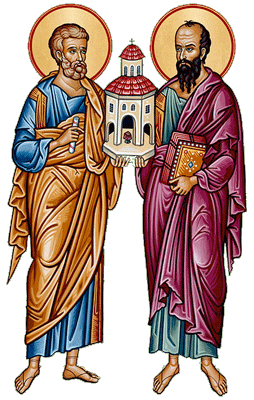
Welcome to Saints Peter and Paul Russian Orthodox Church website.  
Saints Peter and Paul is located in Scranton Pennsylvania.  We are under
the jurisdiction of the Moscow Patriarchate and the part of the Atlantic
States Deanery.   Please contact us with any comments or questions.  
Thank you for visiting Saints Peter and Paul Russian Orthodox Church.
Saints Peter and Paul Russian Orthodox Church Website:
Sponsored by : James and Maryann Capwell
In Memory of: Olga Centi
Counter
Click on the Camera above to
View our Online Photo Albums
The Orthodox Church is the one Church founded by Jesus Christ and his apostles, begun at the day of Pentecost with the
descent of the Holy Spirit in the year 33 A.D. It is also known (especially in the contemporary West) as the Eastern Orthodox
Church or the Greek Orthodox Church. It may also be called the Orthodox Catholic Church, the Orthodox Christian Church,
the one, holy, catholic, and apostolic Church, the Body of Christ, the Bride of Christ, or simply the Church.

The bishops of the Orthodox Churches trace unbroken succession to the very apostles themselves, therefore ultimately
receiving their consecrations from our Lord Jesus Christ. All the bishops of the Eastern Orthodox Churches, no matter their
titles, are equal in their sacramental office. The various titles given to bishops are simply administrative or honorific in their
essence. At an ecumenical council, each bishop may cast only one vote, whether he is the Ecumenical Patriarch or simply an
auxiliary bishop without a diocese. Thus, there is no equivalent to the Roman Catholic papacy within the Eastern Orthodox
Churches.

As with its Apostolic succession, the faith held by the Church is that which was handed by Christ to the apostles. Nothing is
added to or subtracted from that deposit of faith which was "handed once for all to the saints" (Jude 3). Throughout history,
various heresies have afflicted the Church, and at those times the Church makes dogmatic pronouncements (especially at
ecumenical councils) delineating in new language what has always been believed by the Church, thus preventing the spread of
heresy and calling to repentance those who rend asunder the Body of Christ. Its primary statement of faith is the
Nicene-Constantinopolitan Creed.

The Orthodox Church recognizes as authoritative the decisions of the seven ecumenical councils that met between 325 AD
and 787 AD and defined the basic doctrines on the Trinity and the Incarnation. In later centuries Orthodox councils also made
doctrinal definitions on Grace (1341 AD, 1351 AD) and took a stand in reference to Western teachings.

The Church keeps the early traditions of Christianity, infants receive the Eucharist and confirmation, and the episcopate and
the priesthood are understood in the light of Apostolic succession. (Apostolic Succession is understood to be the passing on of
the Holy Tradition by right-believing Bishops). Both married men and monks may become priests, but priests, bishops, and
monks may not marry. The veneration of Mary, as Theotokos (Mother of God) is central to Orthodox Incarnational Theology,
and the intercession of saints is also emphasized in the Orthodox Holy Tradition.

After an early controversy on the subject, the Icons, of Christ, the Virgin Mary, and the saints are now seen as visible
witnesses to the fact that God has taken human flesh in the person of the Lord Jesus Christ.

The Liturgy used by the Orthodox Church has been translated from Greek into many languages. It is always sung, not just
spoken. The faithful receive Holy Communion on a spoon. They are given both the consecrated bread (NIKA), and the
sanctified wine from the gifts offered and sanctified at the given Divine Liturgy. Holy Communion is never taken from any
"reserve."

Monasticism, which had its origins in the Christian East (Egypt, Syria, Cappadocia), has since been considered in the Orthodox
Church as a prophetic ministry of men and women, showing through their mode of life the action of the Holy Spirit. The
monastic republic of Mount ATHOS, Greece, is still viewed among Orthodox Christians as a center of spiritual vitality.
Saints Peter and Paul Russian Orthodox Church
A Parish of the Moscow Patriarchate
Archpriest Basil Micek, Pastor                                                                   1897-2013  116 years